Right now in 2026, everyone is talking about AI rules, deadlines, and paperwork checklists. But there’s a bigger and more urgent problem that almost no one is discussing.
Many companies are already using self-running AI agents in their real work and if those agents make a mistake or cause harm, nobody is 100% sure who will be held responsible by the law.
For years, AI “compliance” was easy: just put the AI tools in a spreadsheet, write a policy document, and you were done. That was never enough, but now in 2026 it’s actually dangerous.
The big difference is autonomy, meaning the AI can act by itself.
Laws were written for decisions made by people, not by AI that acts alone. So the old rules don’t fit well anymore.
Under the EU AI Act, if you use these self-running AI agents in important areas like hiring, loans, healthcare, or essential services, your company is directly responsible for whatever the AI does.
Courts are still trying to decide: Is it the company using the AI (the “deployer”) or the company that built the AI (the developer) who gets blamed when something goes wrong? This question is still not fully answered.
In May 2026, Microsoft's security team published a direct demonstration of what this gap looks like in practice. Researchers identified two critical vulnerabilities in Semantic Kernel, one of the most widely used AI agent frameworks, where a single malicious prompt was enough to trigger host-level code execution on the device running the agent. No browser exploit. No malicious file attachment. Just a prompt, piped directly into a system call without a gate in between. Both vulnerabilities carried a CVSS severity score of 9.9, the near-maximum on the scale. Microsoft's analysis noted that across agentic frameworks broadly, six confirmed remote code execution disclosures were logged in May alone.
This is not just sloppy coding in small projects. Popular tools like LlamaIndex and CrewAI let you build these agents easily, but they don’t automatically add safety controls. That job is left to the engineers and many teams are skipping it.
Because of this, one small mistake by the AI (like a hallucination or bad input) can immediately:
…before any person can stop it.
This is no longer just a “compliance” issue. It’s a real business risk sitting inside a system that will blame someone when things go wrong.
Security and compliance teams have started to say:“If your AI system cannot prove it has safety checks between the AI’s answer and the final action, we will not approve it.”
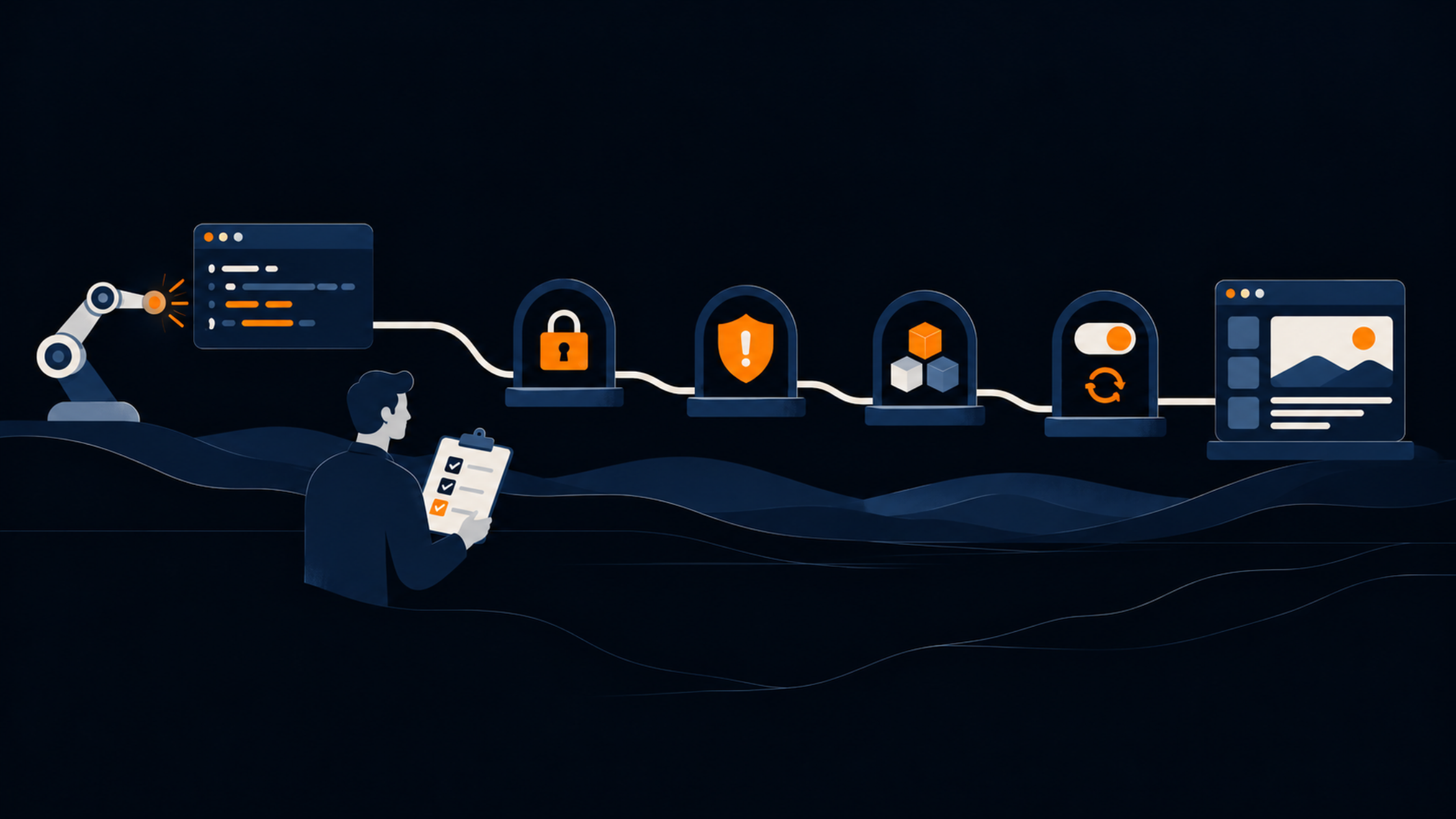
The solution they want is simple: add a “safety gate” (a middle layer) that sits between the AI’s output and the real action. This gate:
These gates must be fast so the system doesn’t slow down.
Companies are also using the international standard ISO 42001 as a basic guide for managing AI. But even that only gives the paperwork side. The real safety rules still need to be written into the actual code.
Having a nice policy that says “our AI should behave well” is not the same as having a system that forces the AI to behave well. Most companies today have the policy but are missing the actual controls.
This is not a future problem, it’s happening right now.
Most CEOs (97%) say their AI projects are doing great and hitting targets. That’s real, AI is making people more productive. But success and good safety rules are two different things.
The companies struggling most are not the slow ones. They are the fast-moving companies that built AI systems quickly and now have to add proper safety rules afterwards.
The EU AI Act gives companies extra time, full rules for high-risk AI systems are now due by December 2027.
The smartest companies are using this extra time to build safety controls into their systems from the start, instead of trying to fix everything later.
The ones who will be safest in 2027 are not the ones who wait until the last minute. They are the ones fixing the safety gap right now.
Remember: the question of “who is responsible when an AI agent causes harm?” is not waiting until 2027. Every self-running AI that is working today is already living inside that legal world.
If your team is thinking about how to add proper safety rules to your AI agents or checking if your current tools are strong enough for enterprise use, now is the perfect time to have that conversation, before an accident makes it urgent, contact us here https://itsavirus.com/contact-us