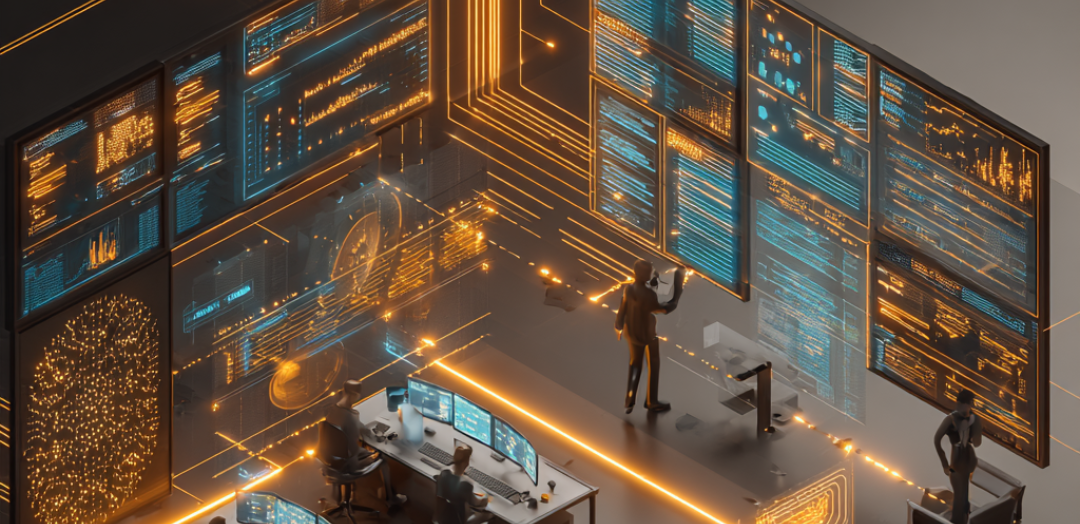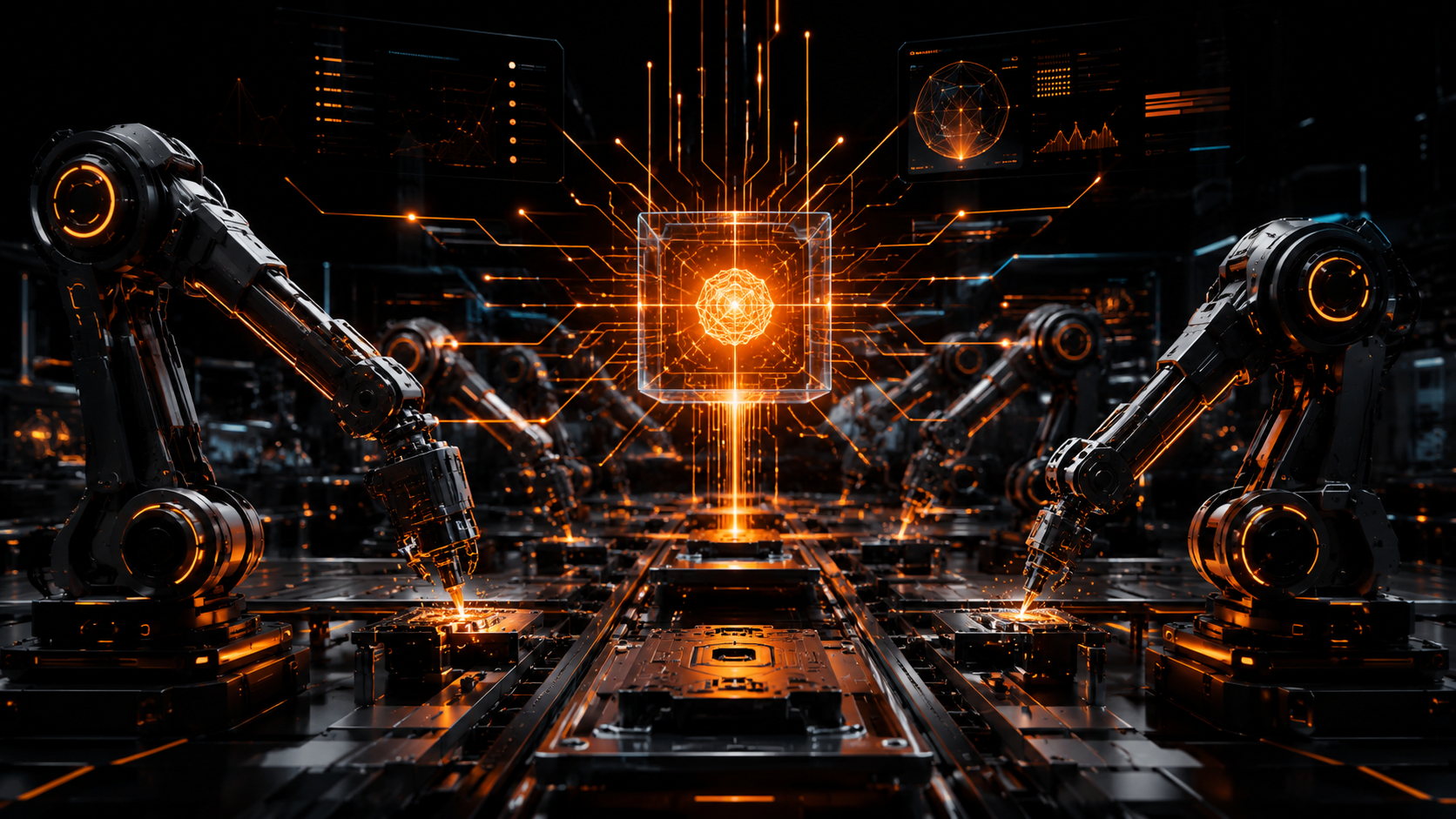
Software AI has a ceiling. It can reason, generate, and summarise but it cannot pick up a box, navigate a factory floor, or respond to a machine breaking down mid-shift. That limitation is now being addressed directly, and the category of technology doing it has a name: Physical AI, a term popularised by Jensen Huang, CEO of NVIDIA, to describe systems that understand physical reasoning, including the laws of physics, friction, inertia, and cause and effect.
There's a version of AI that reads documents, writes code, and answers questions. Most businesses have encountered that version by now. What's less understood is the version being deployed in warehouses, production lines, and logistics networks: systems that don't just process information, but act on the physical world in real time.
Traditional industrial automation was built around precision and repetition. A welding arm does the same weld, at the same angle, in the same position, thousands of times. A conveyor picks the same component from the same tray in the same orientation. The performance is excellent until something changes. Move a component two centimetres. Adjust the lighting. Introduce an unexpected variable. The system doesn't adapt; it stops working.
Physical AI is designed for a different operating condition. It combines sensors, actuators, and AI models into systems that perceive what's actually happening around them, adjust to variability, and improve from experience. The physical world, with all its unpredictability, is the default operating environment, not an edge case to be engineered around.
Deloitte's 2026 paper on Physical AI describes the shift as machines moving from preprogrammed instructions to systems that perceive their environment, learn from experience, and adapt using real-time data. That's a meaningful change in what a machine is, not just what it can do.
Over 500,000 industrial robots were deployed in 2024, with annual installations forecast to reach 700,000 by 2028. According to Citi GPS, there are currently around 405 million robots of all kinds in production globally, projected to reach 1.3 billion by 2035.
The investment numbers reflect the same momentum. 2025 was the strongest year on record for robotics funding, with PE/VC investment reaching $33 billion. Manufacturing robotics funding alone hit $25.7 billion, up from $9.7 billion in 2024.
What matters about these figures isn't just the volume. It's the pace of change relative to where actual enterprise adoption sits today. Just 5 per cent of firms say Physical AI is currently transforming their organisation, yet 41 per cent expect it will within three years. Only 3 per cent have it extensively integrated into operations today, a figure forecast to reach 18 per cent within two years.
That gap between current reality and near-term expectation is where most of the strategic decision-making is happening right now.
The clearest examples are in logistics and manufacturing, where environments are controlled enough to deploy at scale and the ROI case is straightforward to measure.
Amazon now operates over one million robots across its warehouses. Its Sequoia system uses AI and computer vision to make order fulfilment 25 per cent faster and storage 75 per cent more efficient in some deployments. Figure AI has signed a commercial pilot with BMW's Spartanburg plant to deploy humanoid robots on assembly lines, one of the first meaningful deployments of its kind in manufacturing.
The return on investment timeframe for Physical AI deployments in logistics has shortened from an average of 36 to 48 months in 2020, to approximately 18 to 24 months for autonomous mobile robot systems in 2025. That compression in payback period is what tends to move adoption decisions from pilot to programme.
It's also worth being precise about scope. Physical AI is not primarily about humanoid robots, even if that's where most of the media attention sits. It covers smart factories, autonomous vehicles, AI camera systems, delivery drones, digital twins, and sensor-based environments where decisions are made continuously without human input. The humanoid is the most visible expression of a much broader shift.
The gap between a model that reasons well and a system that acts reliably in the physical world is significant, and it's where most of the real engineering challenge sits.
Training a robot in the real world is slow, expensive, and difficult to scale. Every new scenario requires new data, and real-world data collection has hard limits: a human demonstrating a task is still constrained by the hours in a day. The industry's response has been to close that gap through simulation. Models trained entirely in simulation now achieve 80 to 90 per cent of real-world performance, and world foundation models like NVIDIA's Cosmos generate synthetic training data by learning physics, addressing the fundamental data scarcity that has constrained the field. Cosmos can reduce synthetic data generation timelines from months to 36 hours.
On the model side, the pattern from language AI is repeating itself. Google DeepMind's RT-2 achieved 62 per cent success on novel scenarios versus 32 per cent for prior approaches, by leveraging pre-training on web data. NVIDIA's GR00T uses a dual-system architecture, with fast reflexive responses for immediate physical control and deliberate reasoning for planning. The underlying logic is familiar to anyone who has followed how language models developed. The operating environment is not.
The question for most organisations isn't whether Physical AI will become significant. In logistics, manufacturing, and infrastructure, it already is. The question is where it intersects with your operations and on what timeline.
Some of that will be direct: robotics in warehousing, autonomous inspection, AI-driven quality control on production lines. Some will be infrastructural, with the data generated by physical systems feeding into broader operational intelligence. And some will affect adjacent industries in ways that are harder to anticipate from the outside.
The organisations best positioned won't necessarily be the ones that move first. They'll be the ones that understand the technology clearly enough to know where it genuinely applies to their situation and where it doesn't. That distinction, between adopting something because it's available and adopting it because it solves a real problem, tends to be what separates deployments that compound from ones that stall.
If you're working through what this means for your operations, we're happy to think it through itsavirus.com