There is a lot of loose terminology in AI right now, and it is causing real confusion. People use the words 'chatbot', 'AI assistant', 'copilot', and 'AI agent' more or less interchangeably, but they describe very different things. The distinction matters, particularly if you are making decisions about how to adopt AI in your organisation.
The practical implications of getting this wrong are significant. You might invest in a solution expecting autonomous execution and get a fancy search bar. Or you might deploy something with genuine decision-making capability without understanding the risks that come with it. Getting the terminology right is the first step to getting the strategy right.
So let us draw the lines clearly.
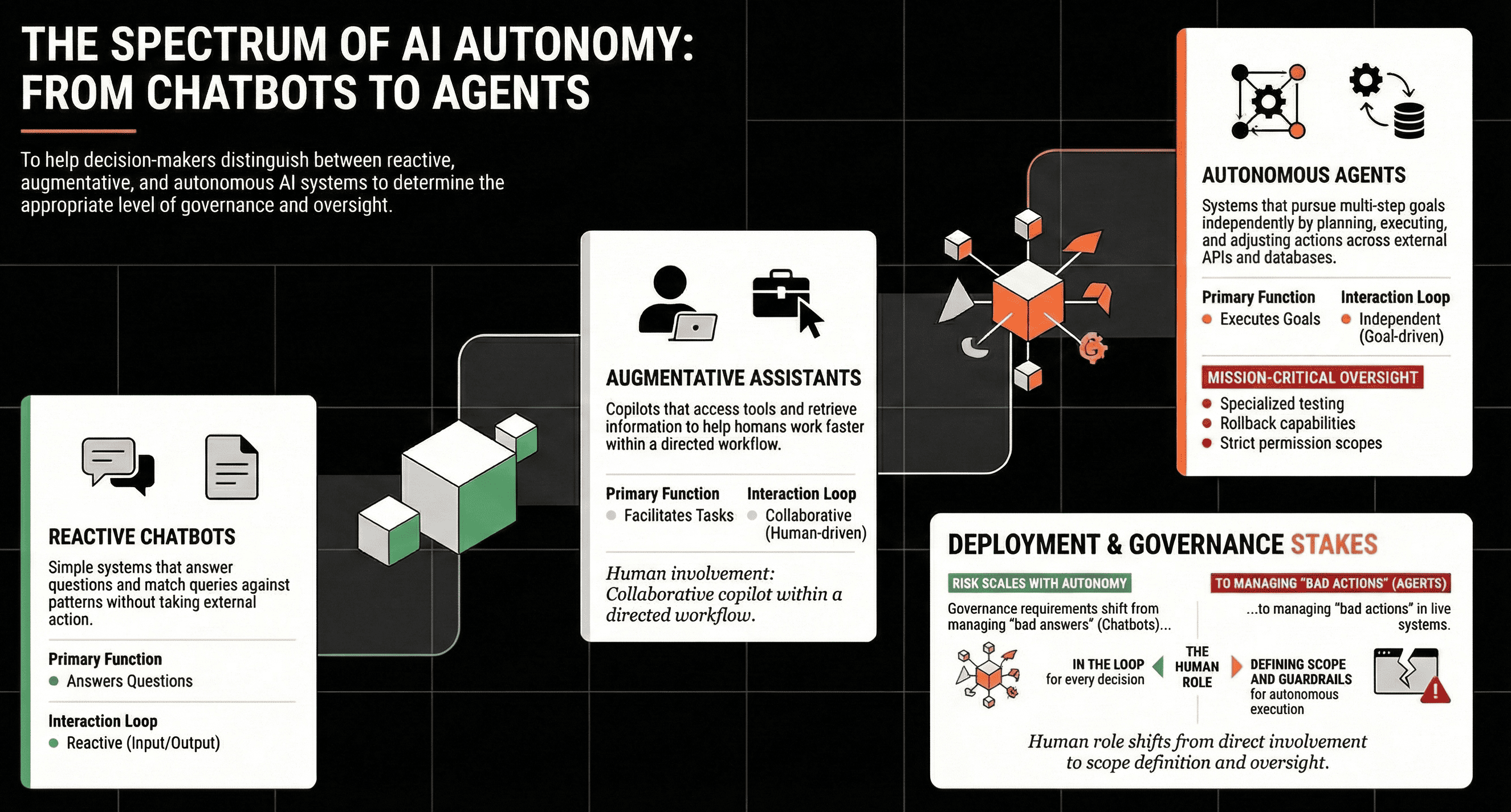
A chatbot is the simplest form of AI interaction. It is a system designed to respond to input, usually text, within a defined structure. Early chatbots were rule-based essentially decision trees dressed up as conversation. You asked a question, it matched your query against a pattern, and returned a scripted response.
Modern chatbots, built on large language models, are considerably more capable. They can understand natural language, handle ambiguity, and produce coherent multi-turn conversations. But at their core, they are still reactive. They wait for input, process it, and return output. They do not initiate, they do not plan, and they do not take action on your behalf.
A customer service chatbot on a website is a good example. It answers questions, routes requests, and handles common queries. It is useful. But it is not doing anything in the world beyond the conversation itself.
An AI assistant, sometimes called a copilot sits a step above the chatbot. The key difference is that an assistant can access tools, retrieve information, and augment your work in real time. It still operates within a human-directed workflow, but it does more than just talk.
Think of GitHub Copilot suggesting code completions as you type, or an AI assistant that can search the web, pull in relevant documents, and summarise them for you within a single conversation. These systems are integrated into your environment. They help you move faster by doing the retrieval and synthesis work that would otherwise take time.
The distinction worth holding on to here is that an AI assistant acts on your behalf in the moment, but the human is still in the loop for every meaningful decision. You prompt it, it helps, you decide what to do with the output. It is a collaboration where the human drives.
An AI agent is a different category entirely. An agent is a system that can pursue a goal across multiple steps, taking actions autonomously, without requiring human input at each stage. It plans, executes, evaluates the results of its actions, and adjusts accordingly.
Where an assistant helps you write an email, an agent might be tasked with monitoring a set of conditions, drafting a response when a trigger is met, sending it, logging the outcome, and escalating if no reply is received all without you touching it. The human defines the goal and the guardrails. The agent handles the execution.
This is where the practical stakes increase. Agents have access to tools; APIs, databases, external services and they act on them. The loop is no longer human-to-AI-to-human; it is AI operating independently within a defined scope. Which is powerful, but it also means the design of that scope matters enormously.
If you are evaluating AI tools for your organisation, the question is not just 'does it use AI?' but 'what is the human doing in this loop, and what is the machine doing independently?'
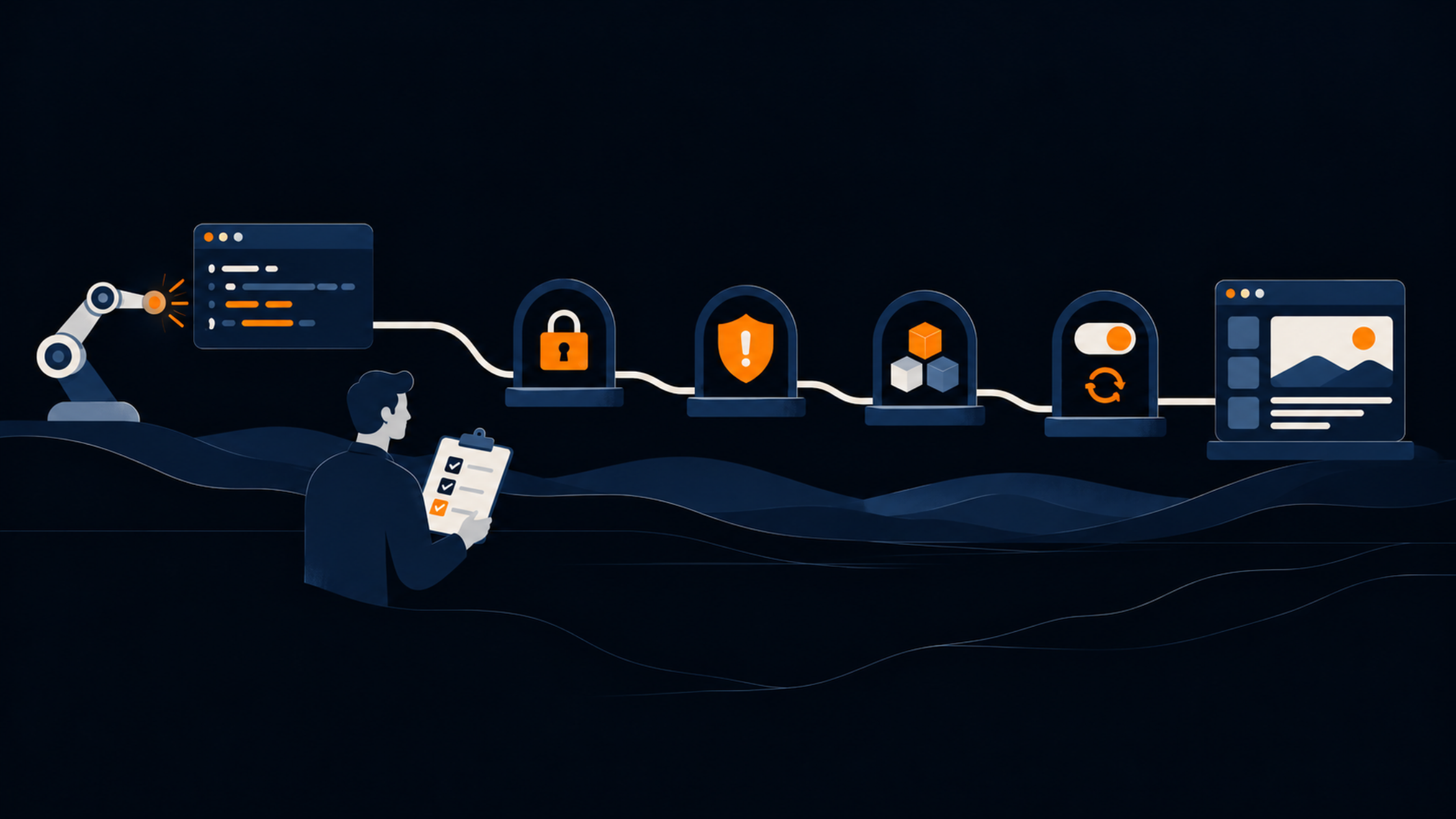
A chatbot deployment is relatively low-stakes from a governance perspective. It can give bad answers, but it cannot take bad actions. An AI assistant connected to your codebase or your inbox has a larger surface area for error, but still requires a human to act on its suggestions. An AI agent with write access to systems and the ability to execute tasks autonomously requires a fundamentally different level of oversight, testing, and rollback capability.
This is not a reason to avoid agents, they represent a genuine step change in what is possible with software. But the organisations that will get the most out of them are the ones that understand what they are actually deploying, not just the marketing description on the packaging.
If it answers questions: chatbot.
If it helps you work faster by accessing tools and information: AI assistant.
If it pursues a goal across multiple steps and takes actions in the world: AI agent.
The lines will continue to blur as the technology develops. Products that started as assistants are gaining agentic capabilities. But the underlying distinction reactive vs. augmentative vs. autonomous remains a useful anchor when you are trying to figure out what you are actually building, or buying.
If you are working through how AI fits into your product or operations, we are happy to think through it with you. No pitch, just a conversation.